Bio
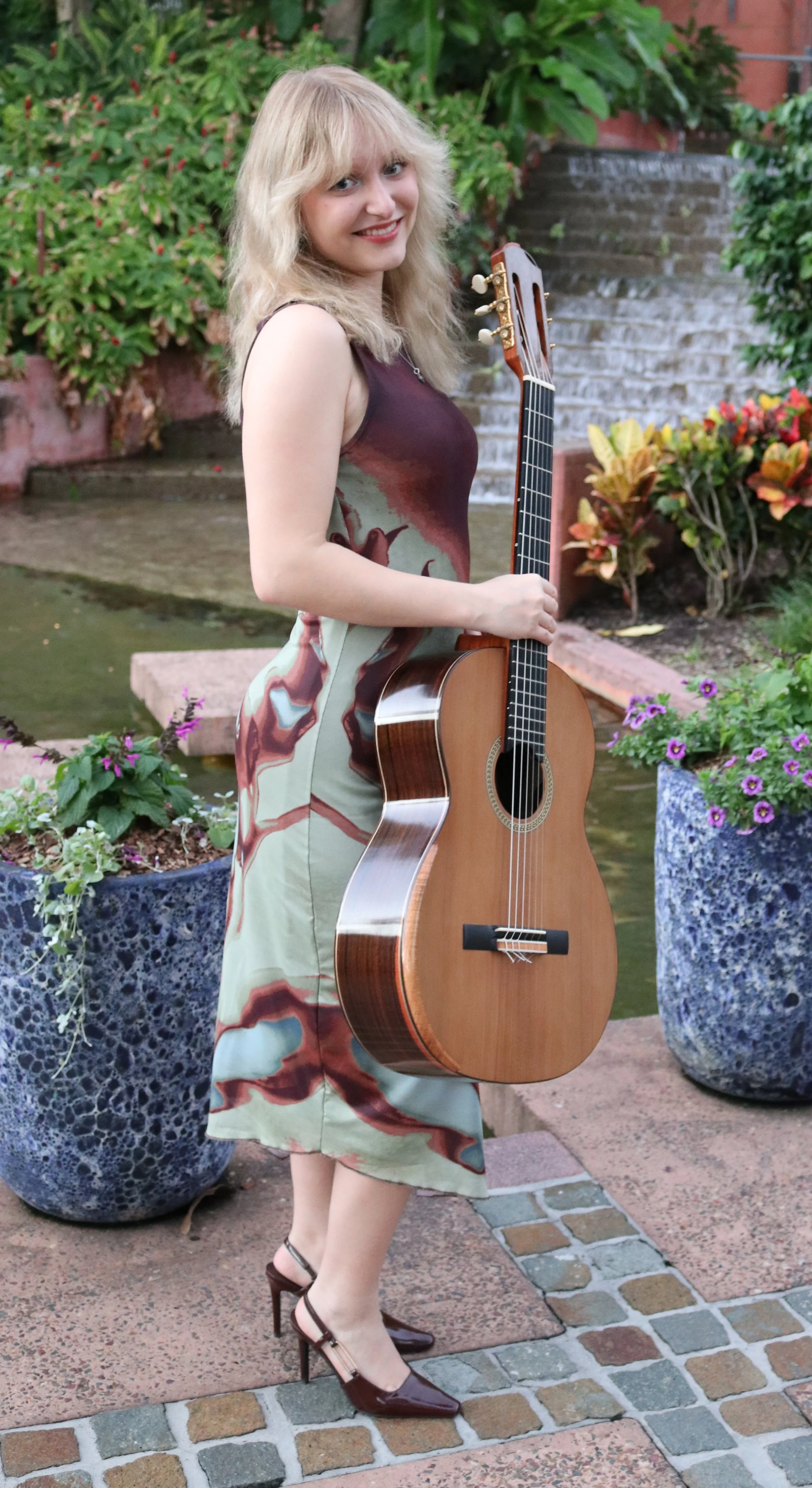
Tara Lynam is an ambitious composer and classical guitarist currently based in Brisbane/Meanjin. Her compositions have received national and international acclaim, including as a Finalist in the 2025 Queensland Music Awards Stage & Contemporary Classical category and as a First Prize Winner at the 2024 Music International Grand Prix in New York. With a passion for the art of storytelling through music, her unique style is characterised by a sense of narrative that has been hailed as “captivating” and “sophisticated”. Her works have gained national radio play and been performed by renowned guitarists including Karin Schaupp, Pavel Ralev, and Harold Gretton. She has recently been commissioned by the Federation of Australasian Mandolin Ensembles (FAME) and the Sydney Guitar School, and has composed new works for groups such as the Riverside Guitar Ensemble, Solstice Guitar Duo, Australian Vocal Ensemble (AVÉ), and Black Square String Quartet.
Throughout her studies at the Queensland Conservatorium Griffith University under the guidance of Karin Schaupp, Tara has pursued a diverse range of performance opportunities as a skilful soloist and an avid member of several ensembles. In 2025 she achieved her Bachelor of Music (Hons I) and was awarded the Robert S. Alva Memorial Award (2024), Griffith Awards for Academic Excellence (2022-25), and the Queensland Conservatorium Guitar Prize (2022). Supervised by Dr. Thomas Green, her Honours research explored the intersection of music composition and astronomical data sonification through the lens of her creative practice, investigating the potential for achieving a balance between effective data representation and musicality. Beyond this project, Tara continues to seek new ways to foster art-science collaboration and share powerful stories through her music.
Research & Projects
Stories of Supernovae: Exploring Sonification as a Composer-Guitarist (2025)
Data sonification, the translation of data into sound, originated as a functional scientific method, with recent literature establishing the notion of a continuum between functional and artistic approaches. As her Honours research project, Tara sought to integrate these typically polarised approaches by investigating data sonification from her perspective of a composer-guitarist. The study explored the sonification of supernova data from the recent Dark Energy Survey (DES) through a practice-based methodology, culminating in the creation of a portfolio of works for classical guitar and digital synthesizers. Co-led by Australian astrophysicist Professor Tamara Davis, the DES supernova program was an international effort that discovered several thousand exploding stars, ultimately presenting a high-quality sample of over 1500 type Ia supernovae. Professor Davis kindly provided the supernova data for use in this project and offered invaluable consultation throughout the sonification process.The compositional portfolio consisted of two multi-movement sonification works. The first, titled Cosmic Journeys, depicts the journey of a supernova’s light from emission in its host galaxy to observation by DES telescopes. In this work, the guitar offers a direct representation of actual observed data, whilst the underlying synthesizers create a swelling drone texture abstractly informed by model (predicted) data. The second work, Cosmic Sparks, portrays what we see: a series of supernovae exploding across the five-year observation period, as scattered sparks across the universe. In this instance, the data is represented by the synthesizers and accompanied by a quasi ab-lib performance on live guitar, interpreting and responding to the synthesizers in real time. In both works, the guitar utilises a uniquely devised alternate tuning, designed so that the pitches of the lowest four guitar strings parallel the wavelengths of the four telescope filters through which supernovae were observed.
Through the entanglement of scientific and musical approaches, this study presents a clustering of purposes: to communicate information about the DES supernovae, to create a musical experience that can be shared through live performance, and to do so through Tara’s individual artistic voice. Ultimately, the study contributes to interdisciplinary discourse and challenges conventional dichotomies between art and science, revealing the potential of sonifications that symbiotically employ musical and scientific perspectives.
You can read more about the DES supernova data that was sonified in this project here and here.